
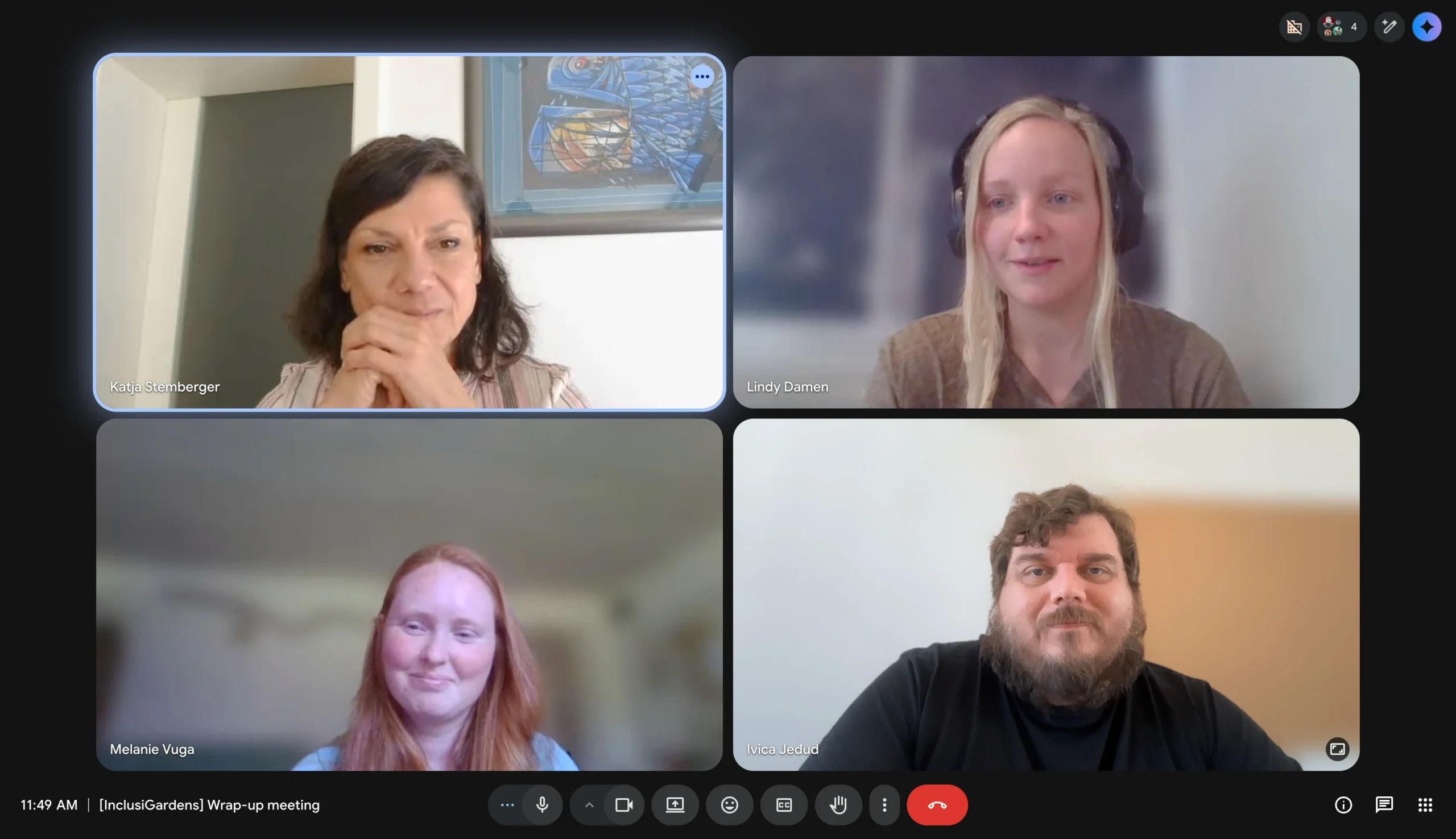
Eighteen months ago, we planted a project seed.
Today, at the last official meeting of the InclusiGardens consortium, we look back with gratitude.
Together with our partners – Društvo za permakulturo Slovenije (Slovenia, the coordinator) and eVRgreen Studio (the Netherlands, project partner) – we set out to do something simple but ambitious: to use urban micro-gardening as a path to social inclusion, and to make the tools to do so freely available to everyone, especially those facing barriers to participation.
When we look at the numbers, we’re proud:
- 7,680 visitors to our Digital Hub (we hoped for 1,000!)
- 18 focus groups bringing together 87 community members, with an additional 34 providing feedback via online surveys (that’s over 120 individuals who participated in co-designing project results).
- 3 workshop series across Slovenia, Croatia, and the Netherlands.
- An e-Cookbook, e-Toolkit, Curriculum, and Gamification Strategies – all available in 4 languages.
- More than 75,000 people reached through events, social media, and EPALE.
But the real harvest isn’t in the numbers. It’s in the conversations we had in focus groups, the hands that touched soil for the first time in our workshops, and the connections built between people who might never have met otherwise.
To everyone who walked this path with us – participants, partners, fellow educators, and our wider community – thank you.
The InclusiGardens project officially ends on May 31st, but our Digital Hub stays open. All resources remain free, downloadable, and adaptable for anyone, anywhere. Because real change doesn’t end when funding does – it continues in classrooms, community gardens, and on kitchen windowsills across Europe.
Let’s keep growing good ideas!

Funded by the European Union. Views and opinions expressed are however those of the author(s) only and do not necessarily reflect those of the European Union or Centre of the Republic of Slovenia for Mobility and European Educational and Training Programmes – CMEPIUS. Neither the European Union nor the granting authority can be held responsible for them.
